Serialized Interactive AT Terminal Broker
Thread-safe serial AT broker daemon preventing command collisions, with history and safety guardrails.
4 min read · Updated
Serialized Interactive AT Terminal Broker
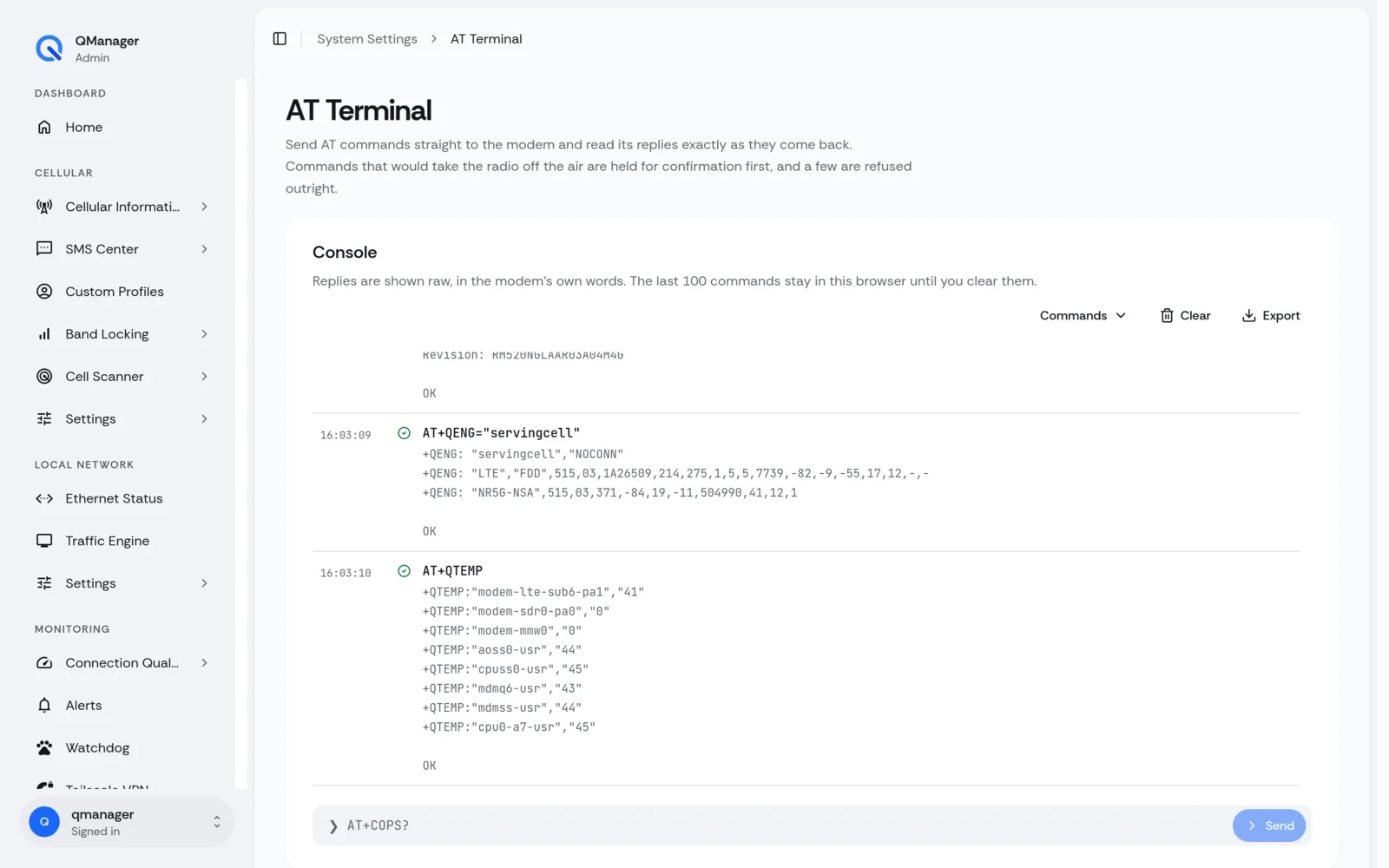
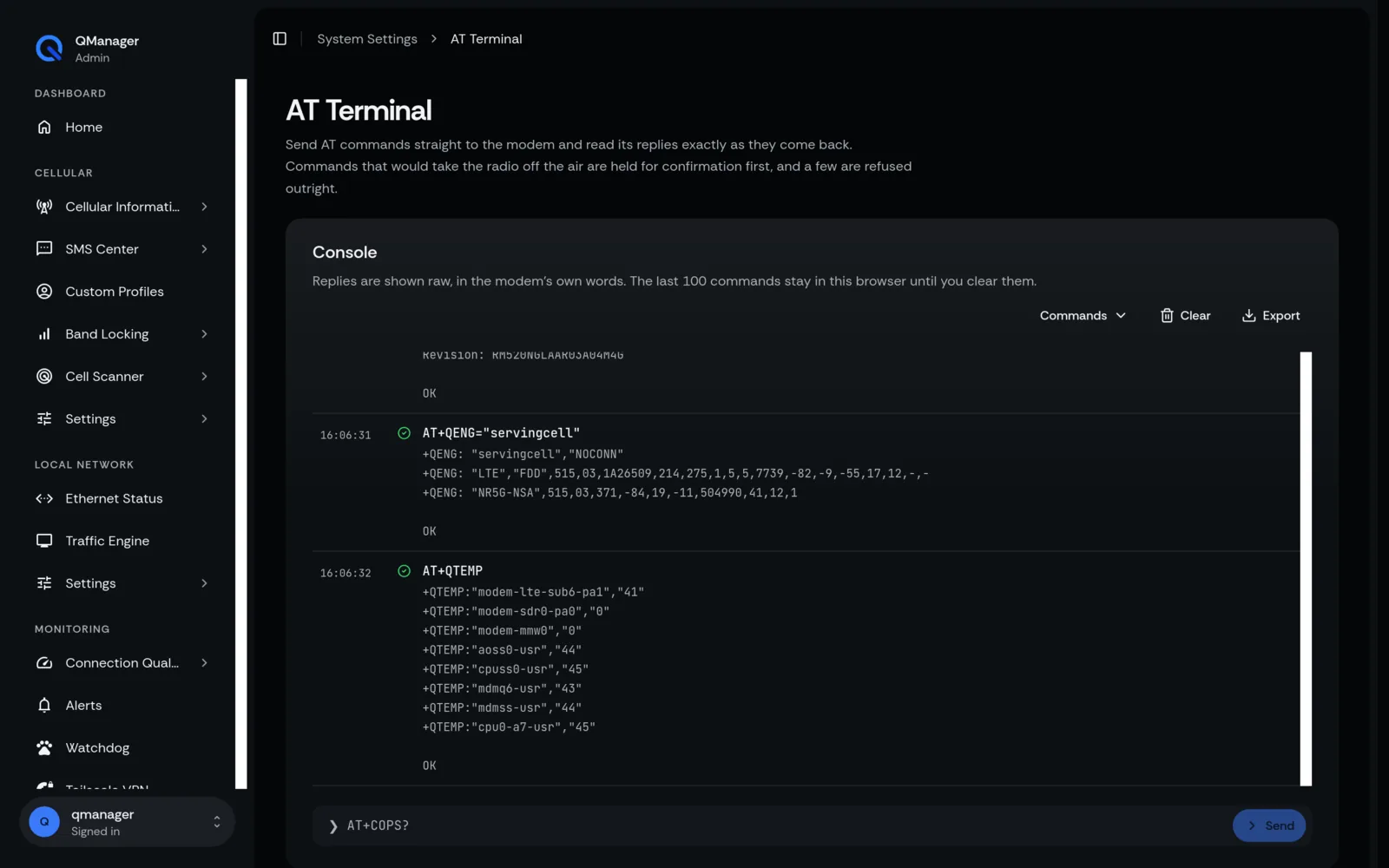
The AT Terminal gives advanced users direct access to the modem's baseband processor while preventing crashes.
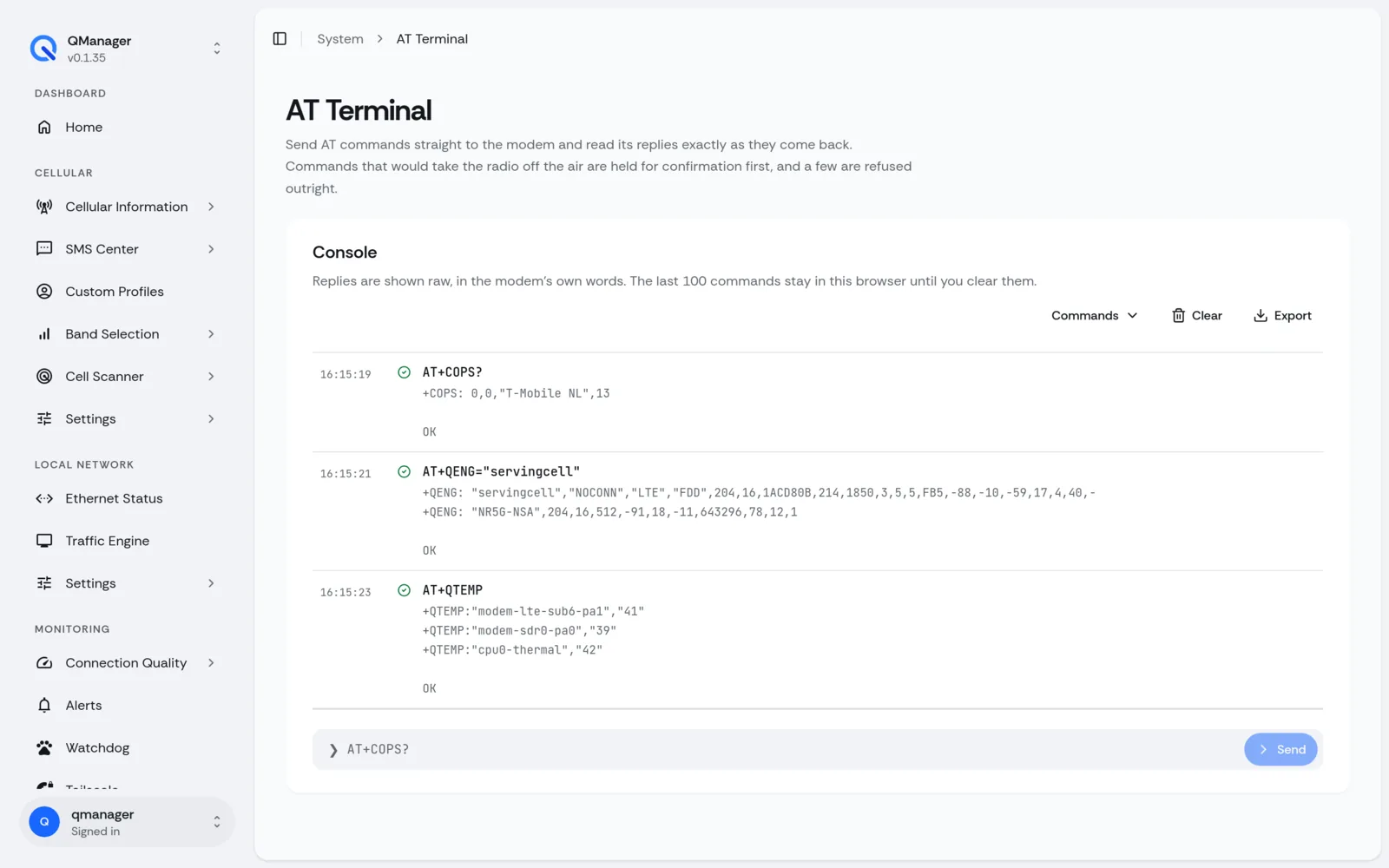
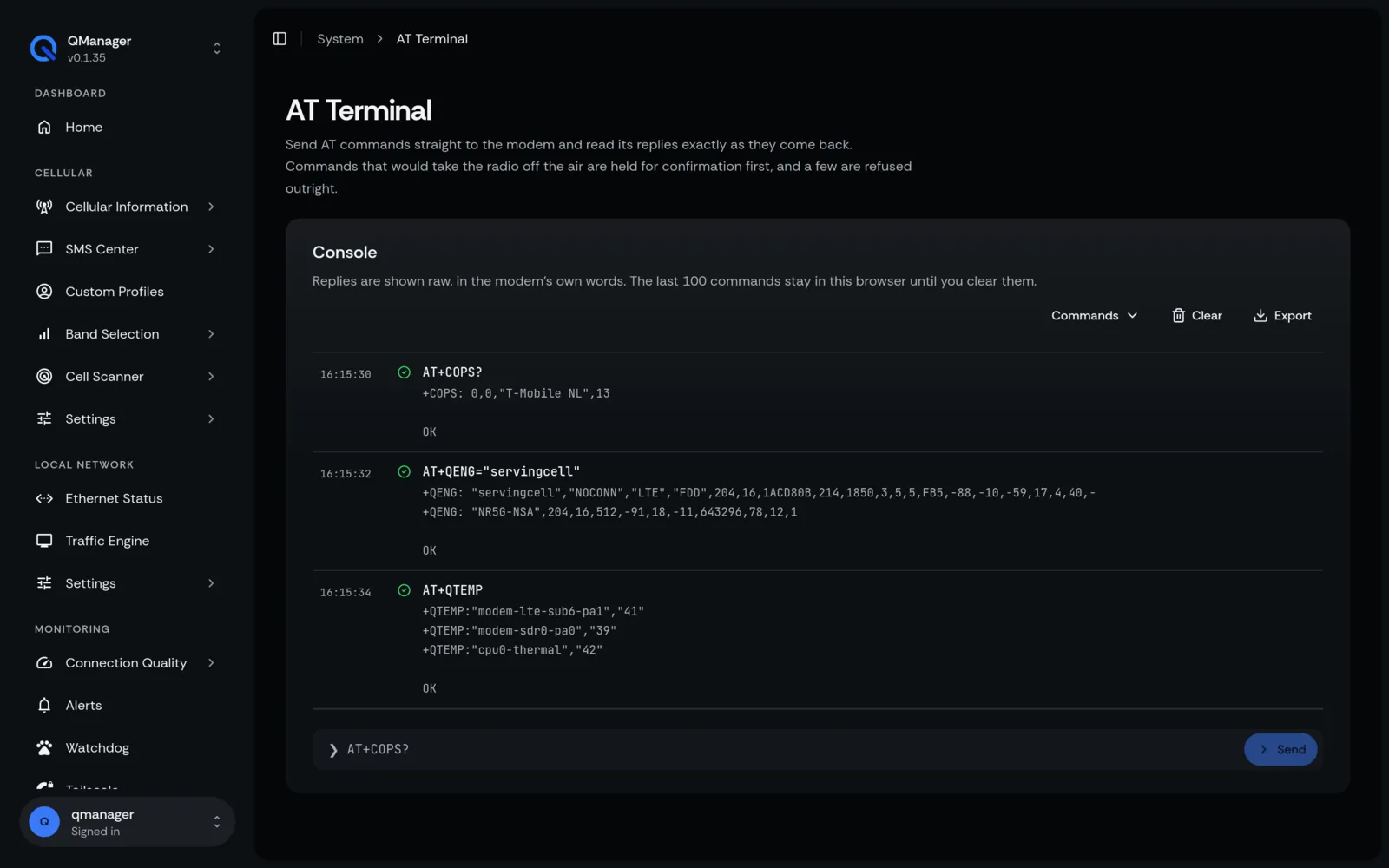
The Serial AT Broker Architecture#
Cellular baseband ports cannot handle concurrent callers: if two processes send AT commands simultaneously to /dev/smd11 or /dev/ttyUSB2, both commands corrupt and the serial channel locks up.
QManager serializes every AT interaction via qcmd:
- RM520N & SDX55/SDX6X Linux: Uses POSIX
flockon/tmp/qmanager_at.lockto gate access through the native ARM binaryatcli_smd11, writing directly to the hardware SMD channel at/dev/smd11without requiring socat or extra bridge daemons. - RM551E & OpenWRT: Serializes access through
qcmdand theqmanager_atddaemon over Quectel serial device channels. - Guarantees sequential atomic command execution with deterministic lock timeouts and zero collision risk.
Virtual PTY Bridging vs Compiled Broker (socat-at-bridge)#
In early open-source Quectel toolkit implementations (such as Nate Carlson and Cameron Thompson's socat-at-bridge), concurrent AT access was achieved by spawning virtual pseudo-terminals (PTYs) using socat:
/dev/ttyINwas bridged to/dev/ttyOUTforwarding into/dev/smd11(modem control channel).- Secondary PTYs (
/dev/ttyIN2//dev/ttyOUT2) forwarded to/dev/smd7for diagnostic telemetry, while OpenWRT utilized/dev/ttySMD11.
Comparative Architectural Analysis:#
| Architecture | Mechanism | RAM / CPU Footprint | Collision Resilience | Round-Trip Latency |
|---|---|---|---|---|
Upstream socat-at-bridge | Background socat PTY processes | High (~15–20 MB RAM per daemon); prone to buffer bloat under rapid polling. | Weak: Simultaneous writes can interleave characters if multiple scripts write without locks. | ~4–8 ms per transaction |
| QManager Compiled Broker | Native Rust ARM binary atcli_smd11 with POSIX flock on /tmp/qmanager_at.lock | Zero idle daemon memory; lightweight on-demand invocation. | Absolute: Hard kernel mutex guarantees complete command isolation. | < 1 ms direct SMD register write |
Atomic Compound Chaining Syntax (";")#
When executing complex multi-step reconfigurations—such as switching APN and restarting the cellular transceiver—issuing individual AT commands sequentially over the terminal introduces latency and intermediate error states.
Quectel Qualcomm basebands support Atomic Compound Chaining delimited by a semicolon (;):
AT+CFUN=0;+CGDCONT=1,"IPV4V6","fast.t-mobile.com";+CFUN=1Chaining Rules:#
- The prefix
ATis supplied only once at the very beginning of the command string. - Each subsequent command is chained with a semicolon (
;) followed immediately by the command symbol (e.g.;+CGDCONT=...). - Commands execute sequentially in a single baseband thread without yielding the serial lock to background pollers.
Interactive Web Terminal Features#
- Command History: Navigate previous commands with Up/Down arrow keys.
- Command Auto-complete: Suggests official Quectel AT syntax as you type.
- Copy Output: One-click button to copy modem response logs for support.
Safety Guardrails & Blocked Commands#
To protect against accidental modem bricking, QManager warns or blocks destructive commands:
AT+QPOWD(Immediate unclean power down).- Erase partition or invalid NVRAM write commands.
Screens in QManager#