Supported Hardware & Modems
Comprehensive compatibility list for Quectel 5G/LTE modules, chipsets, and standalone 5G-to-Ethernet boards that work with any router's WAN port.
5 min read · Updated
Supported Hardware & Modems
QManager is designed to communicate with Quectel IoT cellular modules over standard AT and QMI interfaces. Below is the hardware validation matrix.
Supported Quectel Modems#
| Modem Model | Qualcomm Chipset | Form Factor | 5G / LTE Specs | Validation Tier | Notes |
|---|---|---|---|---|---|
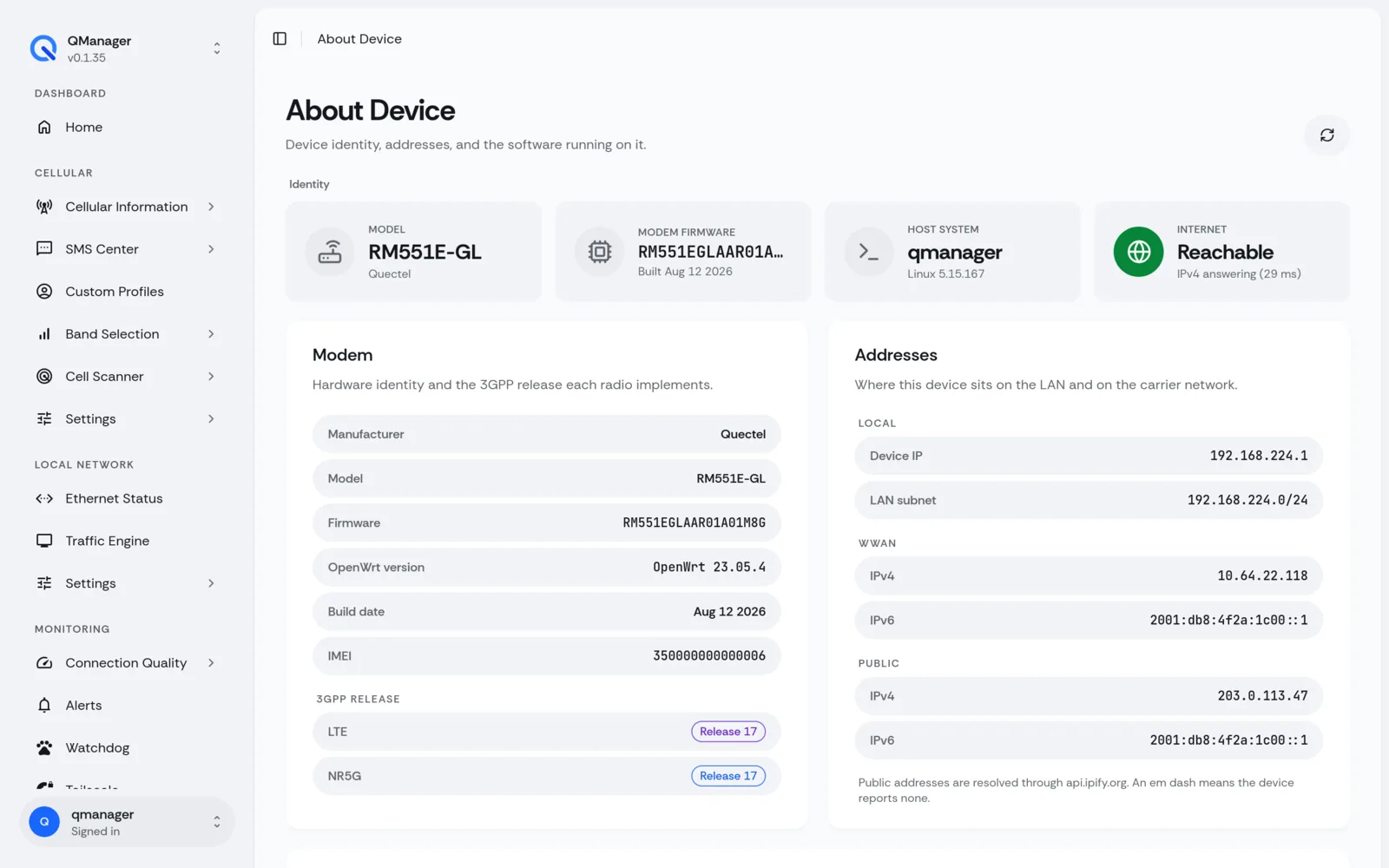
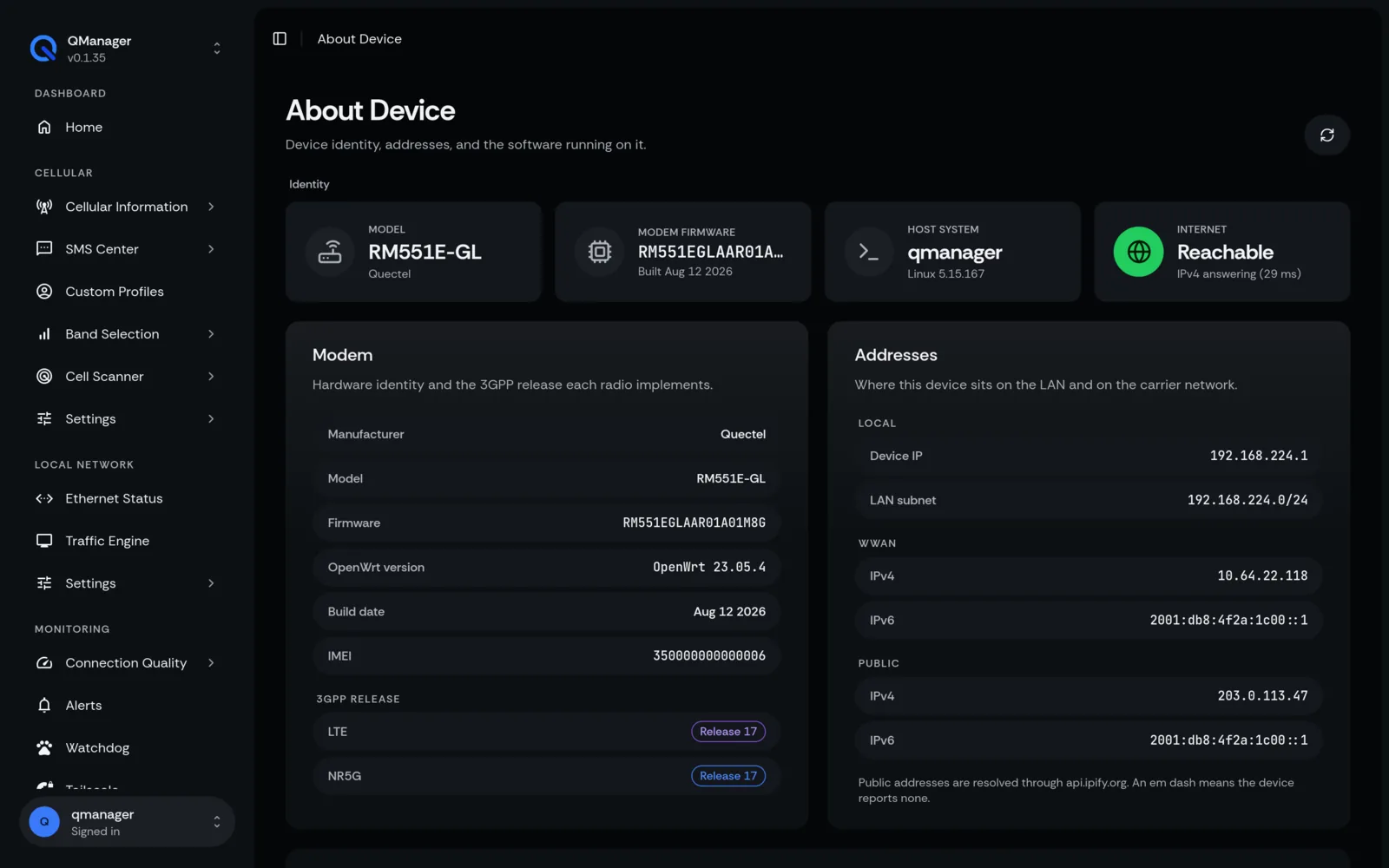
| RM551E-GL | Snapdragon X75 | M.2 Key-B | 5G Advanced Sub-6GHz (7.5 Gbps DL) | Official Reference Platform | Primary reference platform for on-board custom OpenWRT baseband environment. Next-gen X75 module. |
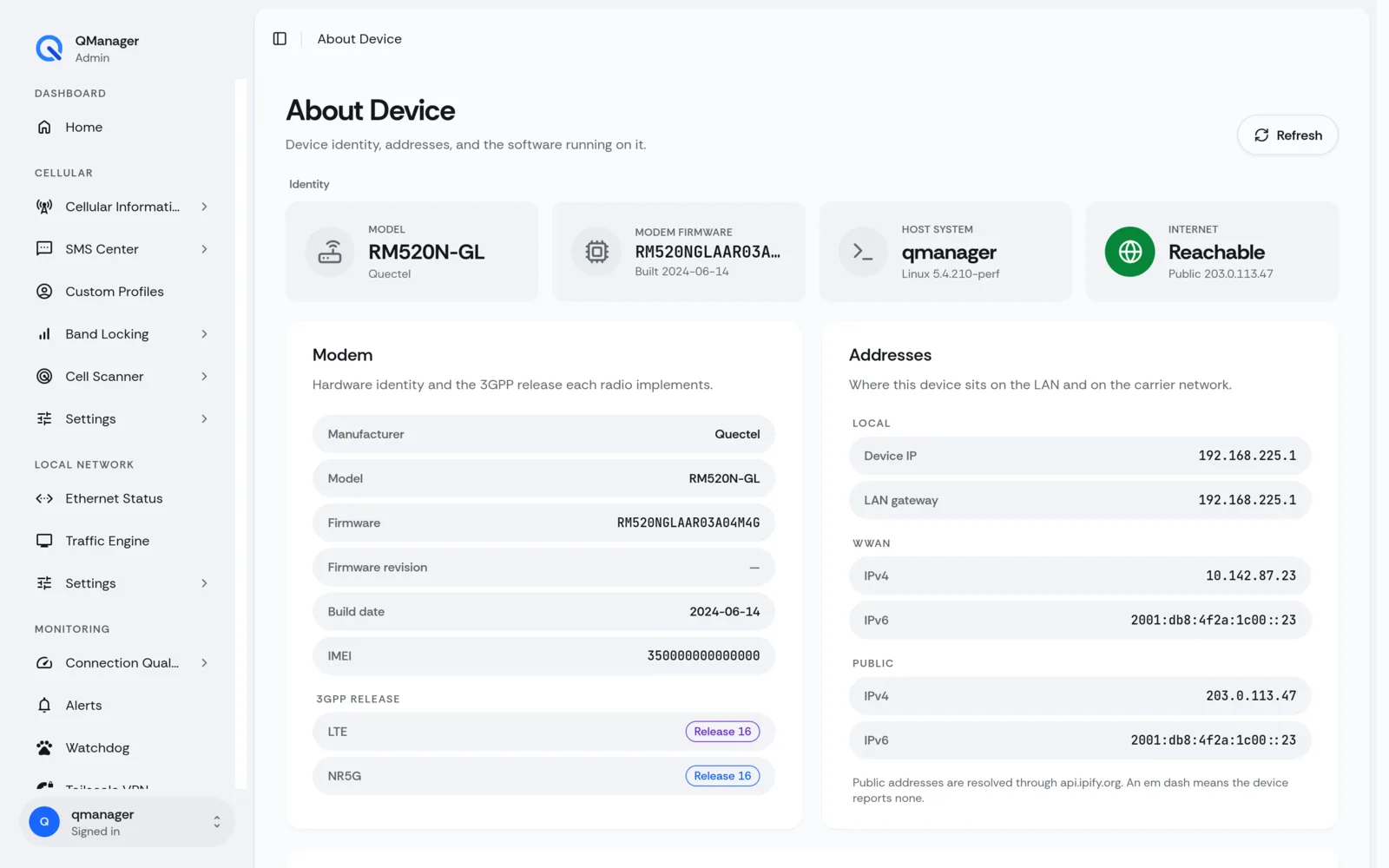
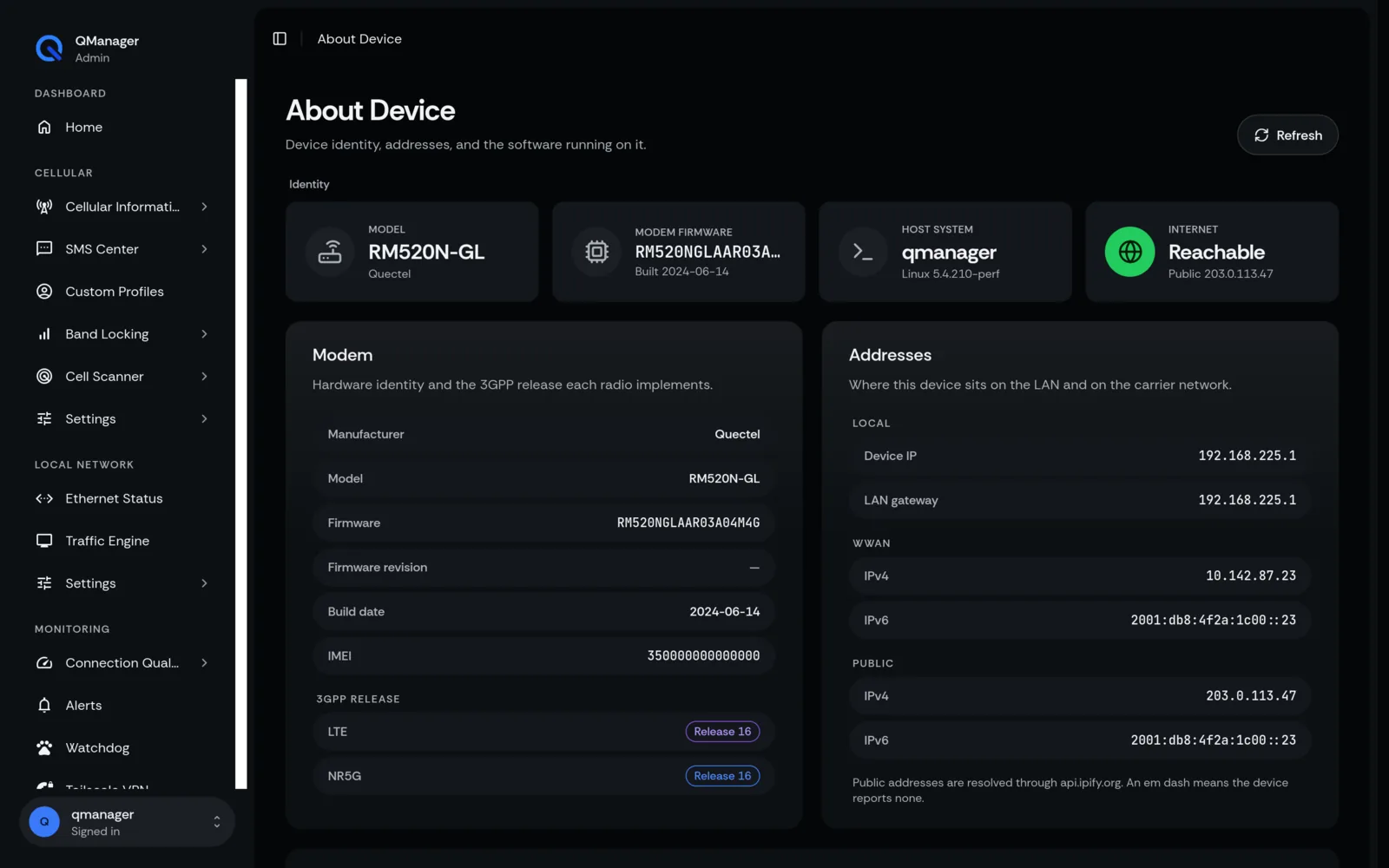
| RM520N-GL | Snapdragon X62 (SDXLEMUR) | M.2 Key-B | 5G Sub-6GHz (3.4 Gbps DL) / LTE Cat 19 | Official Reference Platform | Primary reference platform. Runs native Qualcomm SDXLEMUR Linux on the modem. In a standalone Ethernet board it plugs into any router's WAN port. |
| RG501Q-EU | Snapdragon X55 (SDXPRAIRIE) | LGA Package / Carrier Board | 5G Sub-6GHz (2.5 Gbps DL) / LTE Cat 20 | Hardware-Probed Community | Probed on real silicon (Kernel 4.14, Entware bootstrap tested, runs on-modem Linux at 192.168.225.1). |
| RM521F-GL | Snapdragon X65 | M.2 Key-B | 5G Sub-6GHz & mmWave (7.5 Gbps DL) | Community Experimental | Shares SDX65 baseline architecture with RM520N; unverified by core developer. Community testing welcome. |
| RM550V-GL | Snapdragon X75 / SDXPINN | M.2 Key-B | 5G Sub-6GHz & mmWave | Community Experimental | AA vs AB revisions; sensitive to CFUN 7 EFS traps. Community testing welcome. |
| RG520N-EB / EU | Snapdragon X62 | LGA Package | 5G Sub-6GHz / LTE Cat 19 | Community Experimental | LGA surface-mount variant of SDX62; shares architecture with RM520N; unverified by core developer. |
| RM502Q-AE | Snapdragon X55 | M.2 Key-B / LGA | 5G Sub-6GHz (2.5 Gbps DL) / LTE Cat 20 | Community Experimental | Shares SDX55 baseline; unverified by core developer. Community feedback welcome. |
| RM500Q-GL / AE | Snapdragon X55 (SDXPRAIRIE) | M.2 Key-B | 5G Sub-6GHz (2.5 Gbps DL) / LTE Cat 16 | Community Experimental | Proven 1st gen Qualcomm 5G module architecture; unverified by core developer. |
| RG500Q Series | Snapdragon X55 | LGA Package | 5G Sub-6GHz / LTE Cat 16 | Community Experimental | LGA edition of RM500Q; unverified by core developer. |
| EM120K / EM160R | Snapdragon X24 / X20 | M.2 Key-B | LTE-A Pro (Cat 12/16) | ⚠️ Untested / Unvalidated | Qualcomm LTE-only modules. Never tested by developer or community; compatibility is unknown and unverified. |
| RG500U / EC200 / EG25 | Unisoc / ASR / MediaTek | Various | 5G / LTE | ❌ Unsupported | Non-Qualcomm baseband chipsets lack the required diagnostic AT/QMI interfaces and Qualcomm sysfs hooks. |
Firmware & Architecture Details#
Quectel RM551E-GL (Snapdragon X75)#
- Baseband Chipset: Qualcomm Snapdragon X75 / ARM baseband
- Modem Operating System: Custom on-board OpenWRT baseband environment
- Web Server: Embedded
uhttpdrunning directly on the modem - Control Interface: Standard OpenWRT
uciandnetifdintegration - Deployment: Installs on-modem via the one-line curl installer
Quectel RM520N-GL & RM521F (Snapdragon X62/X65)#
- Architecture: ARMv7l (Cortex-A7 @ 1.5 GHz)
- Modem Operating System: Linux 5.4.180 (vanilla Qualcomm Poky/LE build)
- Flash / Storage: 1 GB NAND Flash,
/usrdataread-write partition (~350 MB free) - RAM: 512 MB LPDDR4x
- Network Interface: Qualcomm rmnet / RGMII Ethernet phy
Router Compatibility & Standalone Ethernet Boards#
Works With Any Router That Has a WAN Port#
A standalone 5G-to-Ethernet board presents the modem to the rest of your network as ordinary Ethernet. Plug the board's RJ45 port into the WAN port of your router and the router treats it like any other internet uplink. No router-side drivers, packages or firmware changes are needed, and QManager keeps running on the modem itself.
This works with:
- GL.iNet routers: Beryl AX, Spitz AX, Flint 2 and the rest of the lineup.
- OpenWrt routers: any OpenWrt device with an Ethernet WAN port, including multi-WAN and failover setups.
- Firewalls & gateways: OPNsense, pfSense, MikroTik and similar.
- Any other router: consumer, ISP and mesh routers that have a WAN port.
Supported Standalone Boards (RGMII / Ethernet Carrier Boards)#
- Rework.Network 5G2PHY: Indoor aluminum desktop enclosure featuring the Realtek RTL8125BG 2.5 Gbps Ethernet PHY, 12V DC input, and SIM slot. Fully validated with QManager.
- Rework 5G-RGM-O: Outdoor IP67 weatherproof aluminum enclosure with integrated mast mount and passive PoE interface.
- Waveshare RM520N-GL to RJ45 Board: Features Realtek or Qualcomm Gigabit PHY with 12V DC input.
- Mcuzone 5G to Gigabit Ethernet Box: Compact aluminum enclosure with cooling fan and nano-SIM slot.
- Custom PCIe-to-RGMII Adapter Boards: Fully supported as long as RGMII pins are routed to the PHY.
Specialty Modems & Cross-Flashing (FM190W, RM550V, RM521F)#
Upstream research by Cameron Thompson (Cellular Modem Wiki) documented several notable module quirks and advanced hardware cross-flashing techniques:
Fibocom FM190W-GL to RM551E-GL ("RMFaux51") Cross-Flashing#
The Fibocom FM190W-GL is architecturally identical to the Quectel RM551E-GL, sharing the same Qualcomm Snapdragon X75 baseband:
- Procedure: Enthusiasts can cross-flash Quectel RM551E-GL firmware onto the Fibocom FM190W-GL using Qflash in emergency mode.
- Calibration Recovery: Because partition layouts differ slightly, modem calibration must be backed up before flashing using QPST (
.xqcnformat) and restored post-flash to preserve cellular RF calibration and IMEI registration. - Result: The converted "RMFaux51" module runs the custom on-board OpenWRT baseband environment and supports QManager natively!
Quectel RM550V-GL (AA vs AB Revisions & CFUN 7 Trap)#
- Hardware Revisions: The RM550V exists in two distinct hardware steppings: AA (early engineering revision) and AB (production stepping). Firmware binaries are strictly non-interchangeable.
- The CFUN 7 Trap: Issuing
AT+CFUN=7(factory test mode) on an RM550V with mismatched EFS NVRAM profiles triggers an unrecoverable RF calibration lockout. QManager's terminal broker automatically flags and intercepts destructive CFUN commands on this module.
Quectel RM521F-GL (Engineering Sample Lifecycle & IP Quirk)#
- Many RM521F-GL modules in community circulation are early Engineering Samples (ES).
- Certain ES firmwares contain a bug where
/data/mobileap_cfg.xmlresets the internal gateway IP to192.168.1.1on every reboot, creating an IP conflict with upstream routers. QManager's on-modem bootstrap automatically patchesmobileap_cfg.xmlto force192.168.225.1.
Realtek RTL8125 PHY Stability Fixes (EEE & ASPM)#
Standalone carrier boards equipped with the Realtek RTL8125 2.5GbE PHY can experience intermittent link renegotiation flaps or high latency under burst loads due to aggressive power-saving states:
- Disabling Energy Efficient Ethernet (EEE / 802.3az):
Energy Efficient Ethernet attempts to place the physical link into low-power idle during transmission gaps, which frequently desynchronizes the RTL8125 PHY.
Or via modem AT configuration on supported firmwares:Shell
ethtool --set-eee eth0 eee offATAT+QETH="eee",0 - Disabling PCIe ASPM & Autosleep (
sdxpinn-patch 3.1): Upstream research discovered that Qualcomm's PCIe root complex autosleep policy inadvertently puts the PCIe controller into L1 sub-states during cellular idle. Applying the communitysdxpinn-patch 3.1disables PCIe ASPM (pcie_aspm=offin kernel cmdline), guaranteeing continuous line-rate 2.5 Gbps stability.
Minimum System Requirements#
- Disk Space: 15 MB free space on
/www(OpenWRT) or/usrdata(Native Linux) - Memory (RAM): 8 MB RAM overhead during active use
- Shell:
/bin/sh(BusyBox ash or bash) - Dependencies (OpenWRT):
curl(strictly curl-only, nowget/uclient-fetch),tar,jsonfilter - Dependencies (Native Linux):
curlorwget(installer bootstraps Entware,lighttpd, andbash)
Screens in QManager#